
Outdoor Education Microscope Kits: Tested & Compared
By Elena Petrov • 2nd May
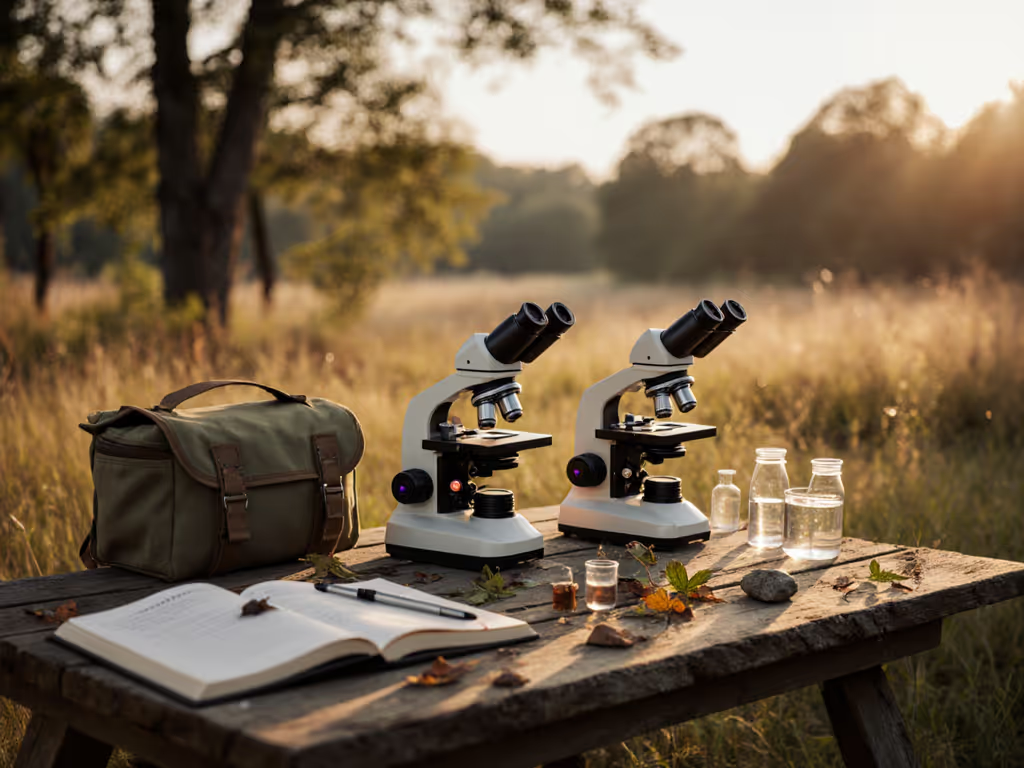
Choosing the right outdoor education microscope kits and nature exploration microscope packages requires moving beyond marketing claims to actual capability assessment. For pro-grade fieldwork, compare our field-ready microscope kits tested in real outdoor conditions. After years of field testing, I've learned that the most effective kits are not always the most expensive (they're the ones where optical design, portability, and educational potential align precisely with what your environment and learners actually need).
What Separates Field Kits from Laboratory Microscopes
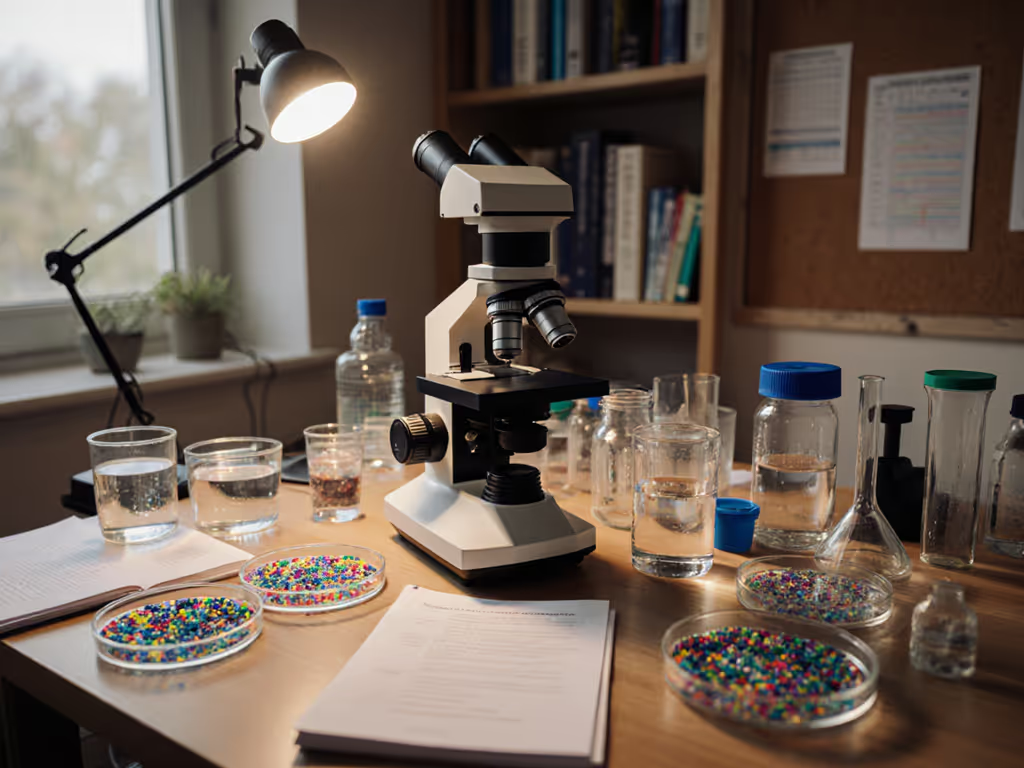
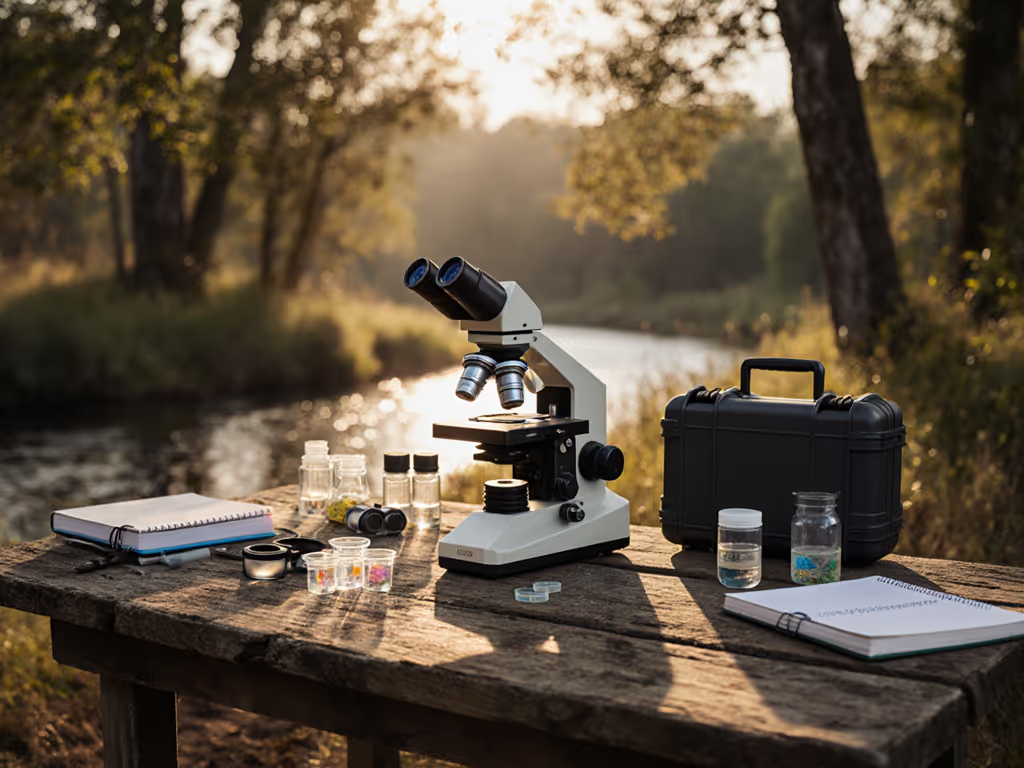
Outdoor education microscopy differs fundamentally from bench-top laboratory work. Your specimens arrive muddy, sometimes still damp. Your optical path includes dust, humidity fluctuations, and direct or reflected sunlight that laboratory microscopes never encounter. A field education microscopy setup must survive this without degrading image quality or reliability.
Laboratory compound microscopes excel at stability and precision under controlled conditions. Field kits prioritize resilience, portability, and functional simplicity. The compound microscope architecture (with objective and eyepiece lenses producing total magnification) remains standard, but implementation details diverge sharply. Water-resistant construction, rugged mechanical components, and simplified focusing mechanisms separate genuine field instruments from laboratory scopes squeezed into backpacks.
This distinction matters because overspending on laboratory-grade equipment for outdoor work typically wastes resources. You are paying for precision you cannot maintain in field conditions. Conversely, undershooting optical capability compromises the core value: discovering what students actually came outside to explore.
Core Components: Separating Function from Marketing
Effective environmental science kits include five functional essentials. First, the optical engine (objective and eyepiece lenses that define both magnification and resolution). Second, illumination, typically LED-based for field use because it generates minimal heat and runs on batteries. Third, a specimen stage robust enough to accept wet mounts without warping or corroding. Fourth, mechanical focusing that remains smooth after temperature swings and handling. Fifth (and this increasingly matters) image capture capability for documentation.
Many kits inflate component counts by listing unnecessary accessories. Testing reveals that more parts do not mean more capability. A borrowed monochrome camera taught me this early in my work: constrain your system deliberately to the modalities that matter. Years later, documenting diatom stacks with a $30 filter that precisely matched my LED wavelength produced results that outperformed equipment costing ten times as much. The difference was not complexity; it was intentional design matching the optical task.
Capabilities matter more than cosmetics; chase modalities, not marketing.
This principle transforms how you evaluate nature center equipment and portable classroom microscopy setups. Ask what each component enables, not what it costs or how many features it lists.
Testing Framework: Beyond Specification Sheets
Test plans beat spec sheets. This is not just philosophy; it is operational method. When comparing outdoor education microscope kits, apply these specific evaluations.
Optical Resolution Under Field Conditions: Magnification and optical quality diverge sharply. A 40x objective might claim resolution of 0.3 micrometers in ideal conditions, but in a field setting with ambient temperature and humidity variation, actual working resolution can degrade 20-30%. Test your candidate kit with prepared reference slides (standard biological specimens with known detail sizes) outdoors in representative conditions. Do not test in your climate-controlled office. Observe how quickly the image degrades as you step away from the optimal optical path angle.
Mechanical Stability and Focusing Range: Spend 20 minutes adjusting focus rapidly through a prepared specimen while varying your head position. Poor mechanical design becomes obvious immediately. The stage should move smoothly without binding, and returning to the same focal depth should not require recalibration. This matters because field specimens often vary in thickness; coarse and fine focus controls need reliable repeatability.
Illumination Consistency: LED sources vary dramatically in spectral output and thermal stability. Observe whether image brightness drifts after the microscope has been outdoors for 30 minutes. Brightness fluctuation indicates the light source lacks thermal regulation, a hidden cost in real-world use because you will spend disproportionate time re-adjusting during each field session.
Durability Under Realistic Handling: Does the kit survive being carried in a standard classroom pack? Can it withstand temperature swings from 40°F to 75°F without optical fogging or mechanical loosening? Place the assembled kit in an equipment bag and subject it to the handling it will actually receive. For better protection and organization on the move, see our microscope field cases compared. Many kits marketed as "field-ready" fail this test because their optical surfaces were not designed for the humidity gradients inside a packed bag.
Magnification vs. Functional Discovery
Here is where many educators overshoot: magnification capability is not proportional to educational value. A field kit with solid 10x, 20x, and 40x magnification covers 95% of outdoor specimen observation. Jumping to 100x oil immersion (possible with laboratory microscopes) requires specimen preparation complexity that negates field simplicity.
Why? Oil immersion demands perfect specimen mounting technique, optical surfaces free of dust or oil smudging, and experience in handling. In a classroom setting with mixed preparation skills, you will spend more time troubleshooting oil immersion than observing specimens. The 10x-40x range lets students discover structure in water droplet organisms, insect wings, leaf tissue, and soil particles without friction.
The practical sweet spot for outdoor education: compound microscope architecture supporting 4x, 10x, 20x, and 40x magnification on a single revolving nosepiece. This covers extreme wide-field observation through to detailed cellular structure, all executable with simple specimen preparation.
Image Capture: Documentation as Educational Tool
Your audience wants to share discoveries. This desire is not cosmetic; it is core to learning engagement. Capturing what you observe deepens analysis and enables peer discussion.
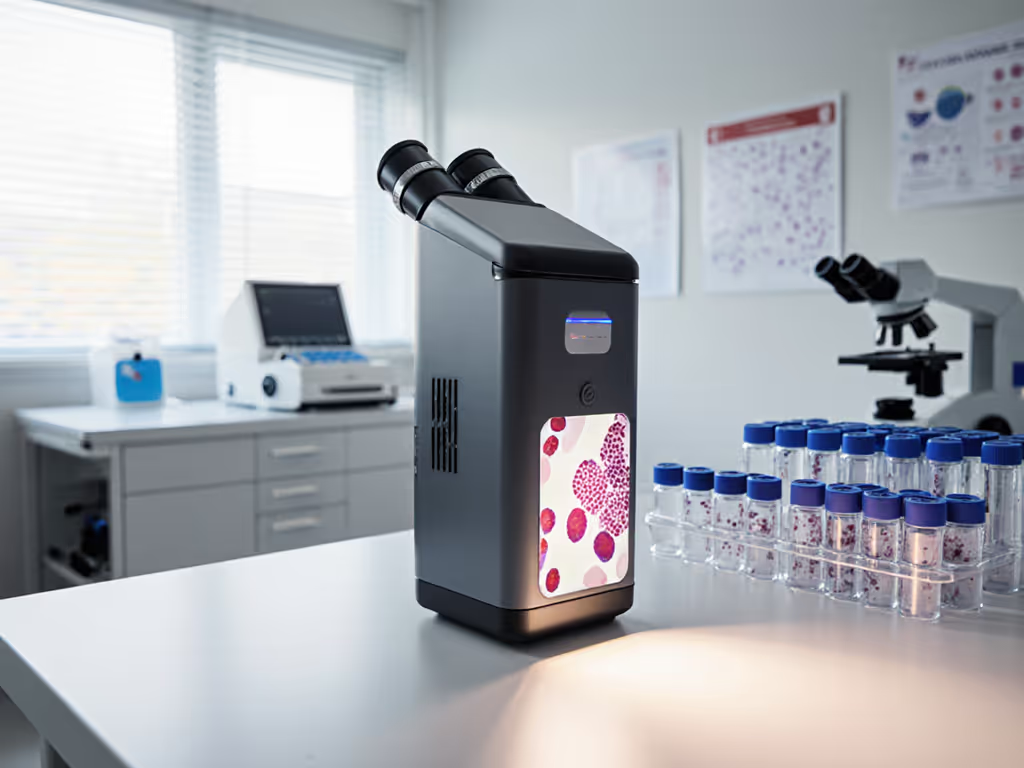
Field kits increasingly include camera integration options. Evaluate these specifically: Does the camera mount securely? Is the imaging software intuitive enough for students with varied computer experience? Does the kit documentation include clear specimen preparation guidance for optimal camera results?
Camera integration costs $150-400 more but typically delivers proportional value for outdoor education. Students who photograph their finds often revisit those images days later, noticing details they missed during live observation. From a pragmatic standpoint, this multiplier effect justifies the expense for serious educational programs.
Optical Quality and Contrast Methods
Brightfield illumination (standard light shining from below the specimen) works adequately for many applications. However, subtle specimen detail often requires optical contrast enhancement. Phase contrast and darkfield illumination reveal structure invisible in brightfield, but they demand more sophisticated optical design. To choose the right method for your specimens, read our phase contrast vs darkfield comparison.
Field-ready kits rarely include phase contrast because it requires specialized objective lenses and turrets. However, some educational kits now offer interchangeable brightfield/darkfield illumination systems that do not require optical modification. This represents genuine capability expansion: students can switch between contrast methods to explore how illumination technique changes what they observe.
When evaluating contrast capabilities, test how quickly a student can switch methods without lengthy recalibration. If transitioning takes five minutes and requires instructor intervention, it will not survive actual classroom deployment.
Durability and Real-World Field Performance
A microscope that works perfectly on your desk but fails after two weeks of being transported to field sites is an expensive waste. Evaluate durability through specific wear points: mechanical focusing knobs should move smoothly after 100 focus cycles on rough terrain. Electrical connections should resist corrosion from humidity without requiring dielectric grease maintenance. Glass optics should resist fogging without constant re-cleaning.
One pragmatic caveat: no kit is completely maintenance-free. All field equipment requires post-use inspection and occasional cleaning. The difference between good and poor field kits is maintenance frequency. Budget $20-30 annually for optical cleaning supplies and spare parts for quality kits; poor designs demand $100+ annually in replacement parts and troubleshooting time.
Price vs. Capability Expansion: Where Your Budget Matters
Field microscope kits range from $200 to $2,000. Understanding this price distribution helps rational selection.
In the $200-400 range, you get basic compound optical architecture, adequate illumination, and simple mechanics. These kits handle 80% of outdoor education objectives: observing macro structures in plants, insects, water organisms, and soil.
At $500-1,000, kits typically add mechanical refinement, better optical coatings that reduce aberration, improved illumination consistency, and sometimes basic camera integration. Real capability gains happen here; image quality noticeably improves, and field reliability increases markedly.
Above $1,000, you are generally paying for advanced features: higher magnification objectives, specialized contrast capabilities, or advanced camera systems. For outdoor education, this tier offers diminishing returns unless your program specifically requires high-magnification specimen analysis.
Honest assessment: your budget multiplier for capability expansion stops around $800-1,000 for field education work. Spending beyond that addresses instructor preferences rather than student learning outcomes.
Addressing Real Pain Points
Your audience faces specific frustrations. Blurry images often stem from inadequate optical coatings or specimen preparation errors (solvable through kit selection and documentation). Finding compatible accessories often requires buying complete systems rather than mixing components; reputable field kit manufacturers bundle complementary parts.
Feeling overwhelmed by technical jargon is resolved through honest testing documentation. Kits from manufacturers who provide clear optical specifications, performance benchmarks under realistic conditions, and transparent limitation statements typically outperform competitors regardless of price.
The challenge of sharing discoveries disappears when kits include integrated camera systems or standardized eyepiece adapter designs that work with smartphone adapters.
Summary and Final Verdict
Selecting outdoor education microscope kits and nature exploration microscope packages succeeds when you prioritize capability assessment over marketing claims. Rigorously evaluate optical performance under actual field conditions, mechanical reliability during realistic handling, and feature sets aligned with your specific educational objectives.
Your most effective choice likely sits in the $500-1,000 range, where optical engineering, mechanical design, and portability genuinely converge. Validate that choice through documented testing: prepare your candidate kits with standard reference specimens, field them in representative environmental conditions, and measure how image quality and operational ease compare under those circumstances.
The kit that survives this rigorous process, proves reliable across temperature and humidity ranges, and enables clear student documentation of discoveries will transform outdoor science education. That is not a marketing promise; that is capability-driven selection working exactly as intended.
Related Articles